
Every export document a buyer receives was produced by someone doing something on the production floor. The safety assessment rests on stability and compatibility tests, the declaration of conformity rests on incoming material checks, and the batch record rests on weighing, blending and filling controls. Understanding that chain is what turns a document review from a paper exercise into a quality control conversation, and it is how a premium launch catches a weak supplier before the first commercial order rather than after it.
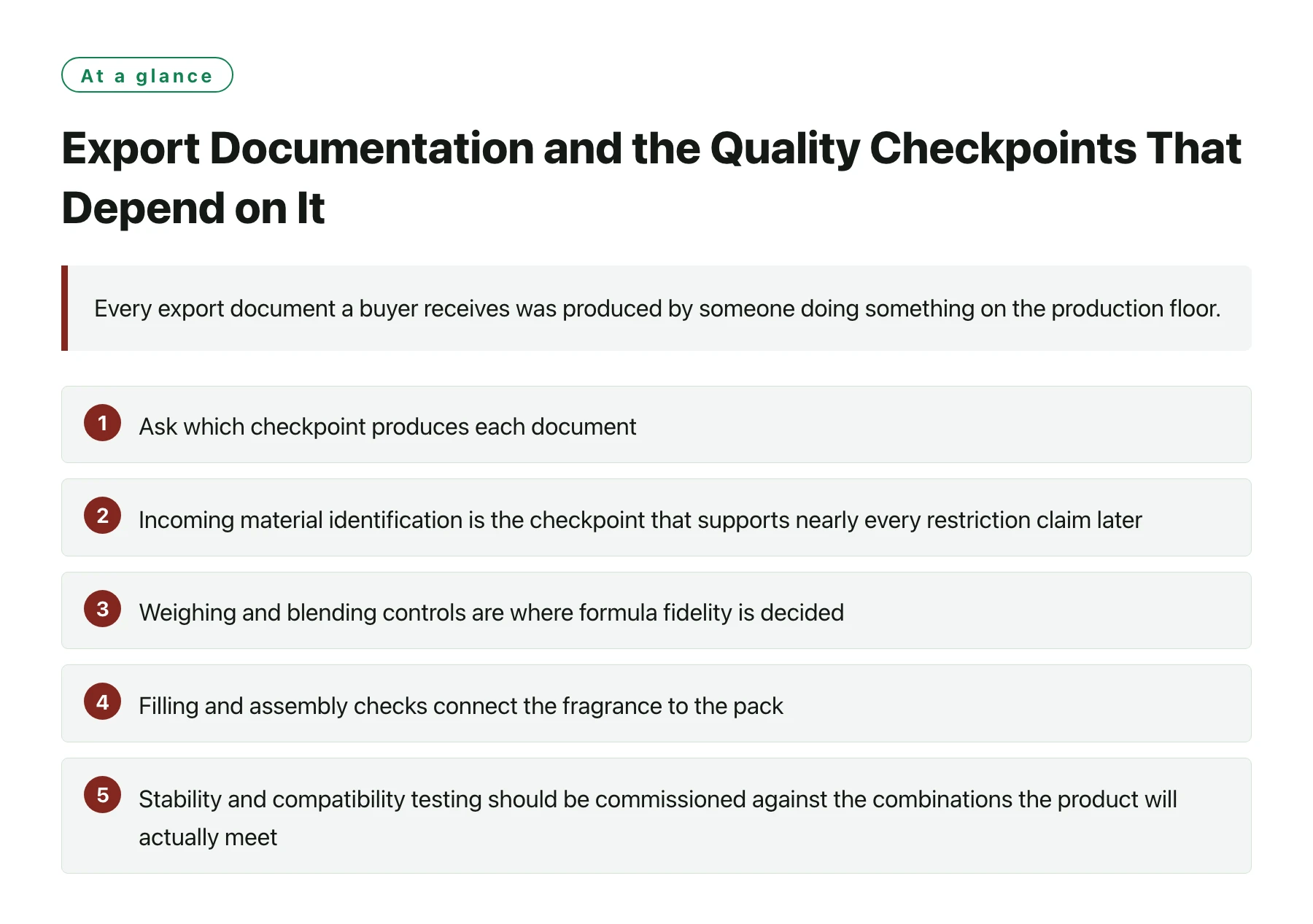
Key takeawaysAsk which checkpoint produces each document, because a document with no checkpoint behind it is a template rather than a record. · Incoming material identification is the checkpoint that supports nearly every restriction claim later, since a conformity statement is only as reliable as the materials actually drawn from the store [1]. · Weighing and blending controls are where formula fidelity is decided, and they generate the records that make a reorder comparable to the original. · Filling and assembly checks connect the fragrance to the pack, which matters because the finished article is what gets notified, labelled and shipped [2]. · Stability and compatibility testing should be commissioned against the combinations the product will actually meet, and the report belongs to the batch family rather than to a single unit. · A batch record that cannot be traced back to the retained reference sample is the most common gap found in an otherwise complete export file [3].
Buyers often treat documentation and quality control as two departments. One sends files, the other inspects goods. In practice they are the same system seen from two sides, and the documents are the output of the checkpoints. That is why a supplier can hold an impressive certificate list and still struggle to produce a batch record, and why a factory with modest marketing can hand over a complete file in a day.
For a premium launch the connection matters more than usual. Higher price points attract closer scrutiny from retail partners and market authorities, and the paperwork is expected to be complete and internally consistent before listing. A file assembled retrospectively, from memory and templates, tends to fall apart under a question as simple as which lot the safety work refers to.
This article walks through the checkpoints that generate export records, in the order they occur, and names what each one produces and what it protects.
The checkpoints, in the order they occur
A fragrance order moves through incoming materials, compounding, maceration or resting, filling, assembly and packing. Each stage has at least one control, and each control produces a record. Reading the sequence as a documentation chain is more useful than reading it as a production description, because it tells you where a missing document actually originates.
1. Incoming material identification
Every restriction claim in the finished file depends on this step. Materials are received against a specification, identified, and released to production only when they match. If this checkpoint is loose, nothing downstream can be trusted, including the ingredient declaration that will eventually appear on the label.
The useful question for a buyer is not whether materials are checked but how the check is recorded and how long the records are kept. A supplier that can show a material release record tied to your batch is describing a system; one that answers in general terms is describing an intention. Restricted material management rests on exactly this discipline [1].
2. Weighing and compounding
Formula fidelity lives here. The composition is weighed against the approved formula, and the record of that weighing is what makes a second production run comparable to the first. This is also where a discrepancy is cheapest to catch, because the material is still in the vessel.
For a premium launch, ask what tolerance applies to the weighing step and how an out-of-tolerance result is handled. The answer reveals whether the factory treats the formula as a specification or as a starting point.
3. Resting, filling and assembly
Once the bulk is blended, the scent usually rests before filling, and the filling line connects the liquid to the pack. Assembly then adds the pump, cap, collar and any decoration. Each of these produces records that later support the claim that a delivered unit matches the approved sample.
The finished article is also what the regulatory file describes, which is why filling and assembly checks feed directly into labelling and notification work rather than running beside it. Product-specific requirements, from ingredient naming to packaging expectations, attach to the article rather than to the fragrance compound [2].
4. Testing and reference retention
Stability and compatibility testing sits across the production sequence rather than at a single point. Its results support the safety assessment, and its timing should be planned so that the report exists before the artwork is finalised.
Reference retention is the quieter checkpoint. A retained sample from the approved batch, held under defined conditions and compared against later production, is what allows a reorder to be checked rather than assumed. Independent testing houses see this gap regularly: a file that looks complete on paper but cannot be tied to a specific lot [3].
Which checkpoint produces which export record
| Checkpoint | Record it generates | What the buyer loses without it |
|---|---|---|
| Material receipt and release | Material release record tied to the batch | Any reliable basis for restriction and ingredient claims |
| Weighing and compounding | Batch manufacturing record with tolerances | Evidence that the order matches the approved formula |
| Resting and filling | Filling record with lot and quantity | Traceability from delivered unit back to bulk |
| Assembly and decoration | Assembly and inspection record | A defensible link between the approved sample and the shipped article |
| Stability and compatibility | Test report covering the relevant combinations | Support for the safety assessment and for shelf-life claims |
| Reference retention | Retained sample record and comparison notes | A way to verify a reorder or settle a quality dispute |
Read as a chain, the table explains why documentation problems almost always trace back to a factory floor habit rather than to an administrative one. It also explains why the process a supplier publishes is worth reading closely: a description of perfume manufacturing process that names its controls is more informative about a launch than any certificate summary, because it shows where records come from.
What this means for a premium programme
Premium positioning is not a quality standard in itself, but it changes the consequences of a gap. A retail partner listing an expensive fragrance is making a promise about consistency, and a batch with a missing record undermines that promise even when the product is fine. The documentation is how consistency becomes visible outside the factory, and it is also how the party named on the label can answer for the product long after the shipment has left, since responsibility for a cosmetic product placed on the market rests with the entity identified on the pack rather than with the factory that filled it [4].
The practical consequence is that quality checkpoints should be discussed before commercial terms, not after. Two suppliers can quote the same unit price and offer very different evidence: one produces records as a by-product of a controlled process, the other assembles them at the end of the project. The difference shows up in the second and third order far more than in the first.
A useful test is to request one complete batch file for a fragrance the supplier already makes, with commercial details removed. It shows the format of every record, the naming convention, the tolerances and the retention practice in a single request, and it is a fair question to ask of any partner being considered for premium fragrance production partner work. The answer says more than a capability deck, because record keeping is the one claim that is difficult to describe convincingly without actually doing it.
Where the fragrance house also runs compounding and filling itself, the chain is shorter and the records are easier to follow, because the handoffs between suppliers disappear. That is not automatically better, but it does mean fewer places for a document to be lost, and it is one reason buyers look for fragrance manufacturing under one roof when the launch schedule is tight. Before shortlisting, read what the group says it owns from compounding to filling at https://www.xuelei.com, then hold that description against the records it can actually produce.
The three records that decide a dispute
If a quality argument ever arises, three records settle most of it: the approved reference sample, the batch manufacturing record for the disputed lot, and the filling record that ties the lot to the delivered units. Everything else, including certificates, is context.
For that reason it is worth confirming at the contract stage that these three will be retained, for how long, and where. A supplier that keeps them as routine practice answers immediately; one that treats the request as unusual is telling the buyer how a future dispute would be handled.
When time is short, do not shorten the documentation review; shorten the list. Name five records you will verify before the deposit: the material release record, the batch manufacturing record, the filling record, the stability and compatibility report, and the retained reference sample arrangement. A supplier that produces all five for an existing product is ready for an exported premium launch, and a supplier that produces three is a supplier with an open question, which is exactly what the review is meant to surface.
Sources
- IFRA: Safe Use and Fragrance Science —— IFRA's explanation of how fragrance materials are scientifically assessed for safe use and how those conclusions are applied by the industry.
- European Commission: Cosmetic Products — Specific Topics —— EU pages covering specific cosmetics topics such as product claims, nanomaterials and animal-testing rules.
- SGS: Cosmetics, Personal Care & Household Testing —— Testing, inspection and certification services for cosmetics and personal care, including microbiological, stability and safety testing aligned with cosmetics GMP.
- European Commission: Cosmetics in the EU —— The European Commission's overview of EU cosmetics rules, including the responsible person, product information file and safety report requirements.
Frequently asked questions
Does a GMP certificate cover the batch records for my order?
No. A certificate such as ISO 22716 shows that the site's cosmetic good manufacturing practice system was audited against the standard on a date. It does not create or certify records for a specific batch. The batch records exist because the process generated them, and they are verified by asking for them rather than by reading a certificate.
When should stability and compatibility testing be scheduled?
It should start once the candidate formula and the fill formats are stable, and finish before the artwork is finalised, because the results feed the safety assessment and the label. Scheduling it later compresses the work and pushes testing into the period when the launch budget is already committed and the schedule has no room for a reformulation.
What is a retained reference sample and why does it matter?
It is a sample kept from a batch that has been approved, stored under defined conditions so that later production can be compared against it. Without a retained reference, a reorder can only be judged by memory or by a fresh sensory panel, and a quality dispute has no fixed point to argue from.
How can a buyer check quality control without visiting the factory?
Ask for a complete batch file from an existing product, redacted. It shows the record formats, the control points, the tolerances and the retention practice in one step. Pair it with a video walkthrough of the filling line if a visit is not practical, and keep the questions tied to specific records rather than to general capability.