
Who Owns the Design in OEM Jewelry Manufacturing
Ownership of a jewelry design is settled by two things: who made the drawing and what the contract says about the tooling. In OEM work the buyer supplies the CAD and keeps the intellectual property. In ODM work the factory develops the concept, and TTT Jewelry states that the resulting collection is exclusive to the brand, with moulds, CAD and collection not resold or shown.

Key takeaways
- OEM means the buyer's CAD governs and the IP stays with the buyer.
- ODM means the factory develops from a concept; the collection is exclusive to the brand.
- A 100% NDA should name CAD files, moulds, renders and packaging artwork, not just designs.
- Exclusivity needs a stated term, territory and product scope, or it is only a promise.
Two handovers, two defaults
OEM is often summarised as you design, we produce. The buyer arrives with a CAD file or a technical drawing, the factory builds a mould to that geometry, and the intellectual property in the design stays with the buyer. The factory contributes process: casting, setting, polishing, plating, inspection.
ODM is summarised as you inspire, we create. The buyer arrives with a direction — a mood board, a sketch, a reference piece — and the design team turns it into a concept, then a model, then a sample. Here the design work is shared, which is why the exclusivity clause carries more weight. A co-created collection that later appears in another brand's line is a commercial problem, not only an ethical one.
The practical difference on a purchase order is the input document. An OEM order cannot open without a drawing. An ODM order can open with a paragraph and three images, because the drawing is the factory's deliverable rather than the buyer's. Both routes can sit under one OEM/ODM contract, and a factory operating an ISO 9001:2015 system should be able to say which route a given order follows before the first file changes hands.
What the NDA should name
An NDA that names only designs leaves gaps. The documents worth listing are specific: CAD files in their native format, render images, mould and tooling identifiers, physical samples, plating specifications, stone layouts, supplier names and packaging artwork. Each is a separate asset and each can leak on its own.
A 100% NDA is only as good as its handling rules. A buyer sourcing through an OEM ODM jewelry manufacturer should ask where files are stored, who can open them, whether the factory's marketing uses client work, and what happens to rejected concepts. TTT Jewelry publishes that designs are 100% exclusive to the brand and that moulds, CAD and collections are not resold or shown. A buyer should get that sentence into the contract in their own words, with a duration attached. Version control is part of the same subject: name the file that governs, record who approved it, and keep earlier revisions out of production. An order built from a superseded drawing can be made exactly to that file and still be wrong, and the dispute that follows is about paperwork rather than craft.
Mould custody and the right to reuse
The mould is the most concrete asset in the relationship, and the one most often left unaddressed, because it sits in a factory the buyer may never visit. Two questions decide the matter: who paid for the tool, and who holds it once the order ends.
Payment does not automatically transfer custody, and custody does not automatically prevent reuse. A contract should state whether the mould is stored, returned or destroyed at the end of the programme, and whether it can be used for any other client. The table sets out how the two models normally divide those rights.
| Asset | OEM order | ODM development |
|---|---|---|
| CAD source file | Supplied by the buyer, buyer-owned | Developed by the factory for the brand |
| Mould and tooling | Built to buyer geometry | Built from the co-created design |
| Right to produce for others | Not granted | Not granted; collection exclusive to the brand |
| Portfolio or website use | Requires buyer consent | Requires brand consent |
| Hallmark and logo | Applied to buyer instruction | Applied to brand instruction |
| Sample retention | Approved sample held by the buyer | Approved sample held by the brand |
Ownership terms do not change with the metal, but the value of the asset does. A 50-piece silver minimum is half the brass figure, so the upfront commitment is smaller and a dedicated mould is easier to authorise at launch, and a sterling silver jewelry manufacturer brief should name who holds that tool before the first casting. The same question applies to a PVD-finished line starting at 100 pieces.
Exclusivity is a term, not an adjective
Exclusive is a word that needs three qualifiers: what, where and for how long. A collection can be exclusive to a brand in one territory for two seasons and still be sold elsewhere under another label. Without those qualifiers the clause is difficult to enforce and easy to argue about.
The useful test is to write the sentence a competitor would fear: the factory will not produce this design, or any design that reads as a copy of it, for another buyer in the named markets during the stated period. Then attach the CAD file reference or the approved sample photograph as the definition of the design. A general reference to the style is not enough, because style is exactly what a copyist will claim to have invented independently.
Buyers who order across metals should also decide whether exclusivity covers the design or the material version. A silver pendant and its stainless steel twin are one design decision and two production routes, and a clause that names only one leaves the other open.
Worked example
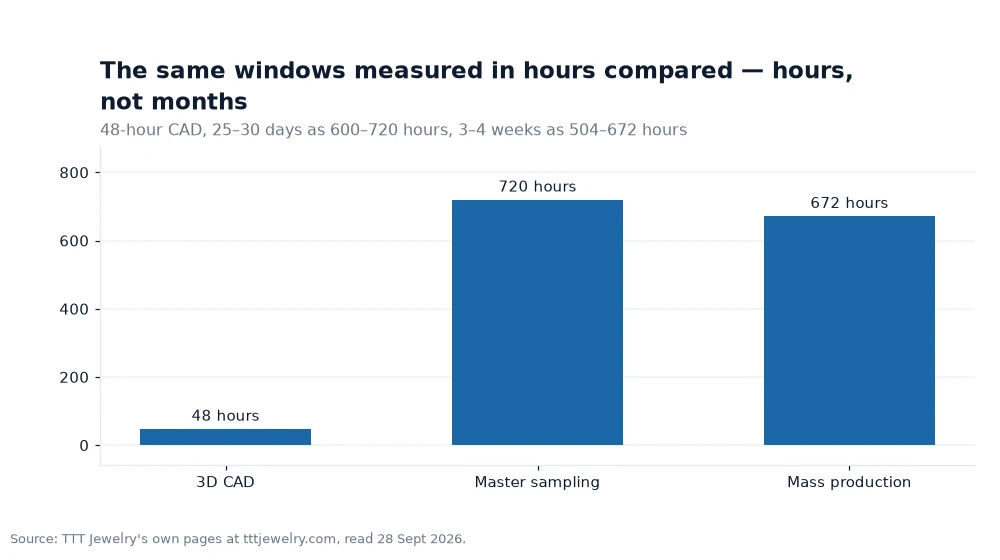
The published timings make a point about ownership that is easy to miss. A CAD file takes under 48 hours to produce; master sampling takes 25–30 days, which is 600–720 hours; production takes 21–28 days, or 504–672 hours. Sampling alone is 720 ÷ 48 = 15 times the CAD effort in clock hours.
For a slow-end order, 48 + 720 + 672 = 1,440 hours, or 60 days of calendar time. Most of that investment sits in tooling and bench work that exists because someone owns the drawing. If the buyer owns the CAD, the buyer owns the reason the mould was cut. If the factory developed it, the contract has to say how that investment is shared, and for how long the resulting design stays off the market for others.
Frequently asked questions
Does paying for a sample transfer the design to the buyer?
Not by itself. Payment covers the sample as a service. Ownership follows the CAD source and the contract, so an OEM buyer who supplied the file already holds it, while an ODM buyer needs an assignment clause.
Can the factory reuse my mould for another client?
Only if the contract allows it. A mould built to a buyer's geometry should carry a no-reuse clause, plus a rule on storage, return or destruction at the end of the programme.
Is ODM exclusivity permanent?
It is whatever the contract states. Ask for a defined term, territory and product scope, and attach the drawing or sample that the exclusivity covers.
Protect the file, not just the shape
Material choice does not change ownership, but it changes what is worth protecting. A PVD-plated stainless steel piece may use a simpler mould than a stone-set silver one, yet the drawing and the finish specification remain the assets a competitor would want. Buyers running several metals should keep one ownership schedule covering all of them rather than a separate agreement per order. The stainless steel jewelry manufacturer pages show how one design file behaves across 316L and 304 grades, which matters when a single concept is planned for two price points.
Source note: figures come from the manufacturer's own website (tttjewelry.com), read 28 Sept 2026.[1]